

News at Boydens
 24th June 2026
Why Housing Law Compliance Matters: Recent Fines Show the Costs of Getting It Wrong
As 2026 unfolds, local authorities across England are flexing their enforcement muscles, issuing significant penalties to landlords who fail to meet their legal obligations. New legislation like the Renters’ Rights Act has tightened standards and increased penalties, while councils are using existing and new powers more aggressively. Fines running into five figures are becoming common when landlords neglect safety and licensing requirements. The cases below illustrate how easily non‑compliance can lead to eye‑watering penalties, and why professional property management is more essential than ever.
Barrow‑in‑Furness: £10,250 penalty for ignoring damp and disrepair
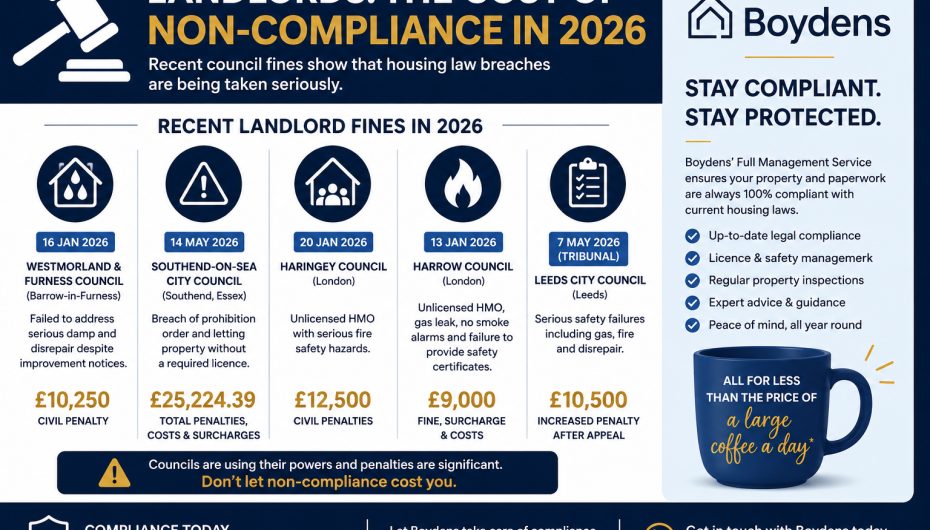
On 16 January 2026 Westmorland & Furness Council hit a landlord with a £10,250 civil penalty after they allowed damp and other hazards to persist in a one‑bedroom flat on Barrow Island. Council officers first received complaints about damp in May 2025. They served a Hazard Awareness Notice, asking the landlord to investigate the damp and carry out remedial works, but nothing was done. When the problems continued, they issued a formal Improvement Notice, requiring the works to be completed by 31 July 2025. Even then, the landlord failed to act. Officers therefore compiled a detailed case file and determined that a civil penalty was appropriate. As Councillor Judith Derbyshire noted, the council prefers to work informally but will not hesitate to use enforcement powers to ensure homes are safe.
This case shows that even seemingly minor issues like damp can lead to substantial fines when landlords ignore statutory notices. It also demonstrates that councils are patient but persistent; they gave the landlord multiple opportunities to comply before imposing the penalty. The lesson for landlords is clear: engage early and fix problems, the cost of doing nothing is far higher.
Southend‑on‑Sea: Prohibition order ignored – £25,000+ in penalties
In Southend, council officers discovered a property being occupied despite a prohibition order and without the required selective licence. At Southend Magistrates’ Court on 14 May 2026, landlord Samuel Nyantakyi was found guilty of letting the unsafe Kilworth Avenue property while illegally profiting from rent. The court recognised the seriousness of the offences and ordered Nyantakyi to pay £14,000 for breaching the prohibition order and £1,760 for failing to obtain a licence. Prosecution costs of £3,160.39 and a £6,304 victim surcharge brought the total to £25,224.39.
Councillor Irene Ferguson said the case sends a clear message that the council will protect residents and hold criminal landlords to account. The size of this fine underscores how seriously courts view breaches of prohibition orders; such orders are issued only when properties pose significant risks. Landlords must understand that ignoring them can lead not only to hefty fines but also to potential imprisonment.
Tottenham: Unlicensed HMO leads to a £12,500 bill and tribunal appeal
Haringey Council’s enforcement teams investigated a rented property on Clonmell Road, N17 after receiving complaints of damp and mould. They found it operating as an unlicensed House in Multiple Occupation (HMO), with serious safety hazards including inadequate fire protection and dangerous stairs. In January 2026 the property owner and their managing agent received civil penalties totalling £12,500 for failing to license the HMO. The managing agent appealed to the First‑tier Tribunal, but the tribunal dismissed the appeal, describing it as misguided and upholding the council’s case. The tribunal ordered the agent to pay their £10 000 fine and added them to the Greater London Authority’s Rogue Landlord and Agent checker.
Councillor Sarah Williams, Haringey’s Deputy Leader, used the case to warn that the council will not tolerate landlords or agents who put residents at risk. The case shows that even where a property is eventually licensed and improved, failure to do things correctly at the outset can be very costly. It also highlights that a tribunal appeal can backfire: not only did the fines stand, but the agent’s name was publicly listed.
Edgware: Safety certificates missing – £9,000 total fine
Harrow Council’s enforcement story began with complaints about rubbish at a four‑bedroom property in Edgware. When officers inspected, they found a suspected unlicensed HMO in a “dangerous state”, the boiler was broken, there were no smoke alarms, and there was a strong smell of gas. An emergency engineer confirmed a gas leak, and the council issued an Emergency Prohibition Order. The landlord failed to provide fire safety and electrical safety certificates, despite multiple requests, and was prosecuted at Willesden Magistrates’ Court. The court fined the landlord £5,000, plus a £2,000 victim surcharge and £2,000 in costs.
Councillor Pritesh Patel emphasised that when officers issue notices they must be taken seriously and promised that the council will continue to put residents’ safety first. Although this fine was smaller than some others, it still represents a significant penalty for failing to produce basic safety documentation. It should serve as a warning that tenants’ safety certificates are not optional paperwork, they are legal requirements.
Leeds: Appeal adds £3,000 to penalty
Sometimes landlords take enforcement action to tribunal hoping to reduce penalties. In Leeds, the opposite happened. Landlord Mohammed Gulzar had been fined £7,500 after officers found multiple safety and management breaches at his property on Bayswater Place, Harehills: the gas meter had been bypassed, fire alarms were defective, and there was inadequate fire protection. He appealed to the First‑tier Tribunal, which re‑examined the case and concluded that the level of harm had been underestimated. The tribunal noted the property posed a “high risk of serious adverse effect on an individual” and increased the financial penalty to £10,500, payable within 28 days.
This case shows that tribunals look closely at the evidence and can increase fines when serious hazards are present. Appeals are therefore a double‑edged sword: they may reduce penalties when councils have over‑reached, but where risks are significant, tribunals can impose higher fines and publicly set out the full extent of the landlord’s failings.
What these cases tell us
Taken together, these fines highlight four crucial trends in 2026:
- Councils are becoming more proactive. Housing enforcement teams respond to complaints quickly, issue notices, and pursue penalties when landlords fail to act. Westmorland & Furness gave a landlord months to fix damp before imposing a hefty fine, while Southend’s team carried out targeted inspections and prosecuted when a prohibition order was breached.
- Courts recognise the seriousness of housing offences. Magistrates’ courts in Southend and Harrow imposed fines plus surcharges and costs, signalling that ignoring licensing requirements or safety notices will not be tolerated.
- Tribunal appeals can backfire. The Haringey and Leeds cases show that appealing fines is not risk‑free. Tribunals will scrutinise the risk to tenants; if they deem it significant, they may uphold or even increase penalties.
- The cost of non‑compliance dwarfs the cost of professional management. Fines of £10 000–£25 000 equate to years of management fees. Even the smallest fine in our examples (£9 000 in Harrow) represents a large financial hit.
A call to action: partner with Boydens for compliance peace of mind
These cases show that being a landlord in 2026 is not a hands‑off investment. Rapid regulatory change, new powers for councils, and harsher penalties mean even well‑intentioned landlords can slip up. Whether it’s serving the correct information sheet by the Renters’ Rights Act deadline, ensuring HMOs are fully licensed, or producing up‑to‑date safety certificates, there are numerous traps for the unwary.
This is where Boydens can help. As an established property management company, Boydens offers a full management service that takes compliance off landlords’ shoulders. Our experienced team monitors changes in housing law, ensures that all safety certificates are up to date, and deals proactively with maintenance issues, often before they become serious. We liaise with council officers, arrange inspections, and keep detailed records to demonstrate compliance.
Importantly, Boydens’ comprehensive management service costs on average less than the price of a large coffee per day. For about the cost of your daily flat white, you can protect yourself from four and five‑figure penalties and the stress of dealing with enforcement action. We believe that is exceptional value. Instead of risking thousands of pounds in fines or being added to a rogue landlord register, you can enjoy peace of mind knowing professionals are keeping your properties fully compliant.
Conclusion
The fines handed out to landlords this year send a clear message: compliance is no longer optional. Councils are acting quickly, courts are imposing substantial penalties, and tribunals are upholding and even increasing fines when tenants’ safety is compromised. Landlords who fail to license HMOs, ignore prohibition or improvement notices, or neglect basic safety checks face heavy financial and reputational damage.
However, these risks are entirely avoidable. By partnering with a reputable property management company like Boydens, landlords can ensure they stay on the right side of the law. With expert oversight, responsive maintenance, and meticulous documentation, you can protect your tenants and your investment. In a climate where the cost of non‑compliance can equal years of rental income, professional management is not a luxury, it is a necessity.
If you’re a landlord concerned about meeting the new standards or worried that you might have missed a requirement, don’t wait for a council letter or tribunal summons. Contact Boydens today and let us handle compliance for you. For less than the price of a large coffee a day, we’ll make sure your properties are safe, legally compliant, and managed to the highest standards, so you can relax and enjoy the benefits of your investment without the fines.