

News at Boydens
 30th October 2026
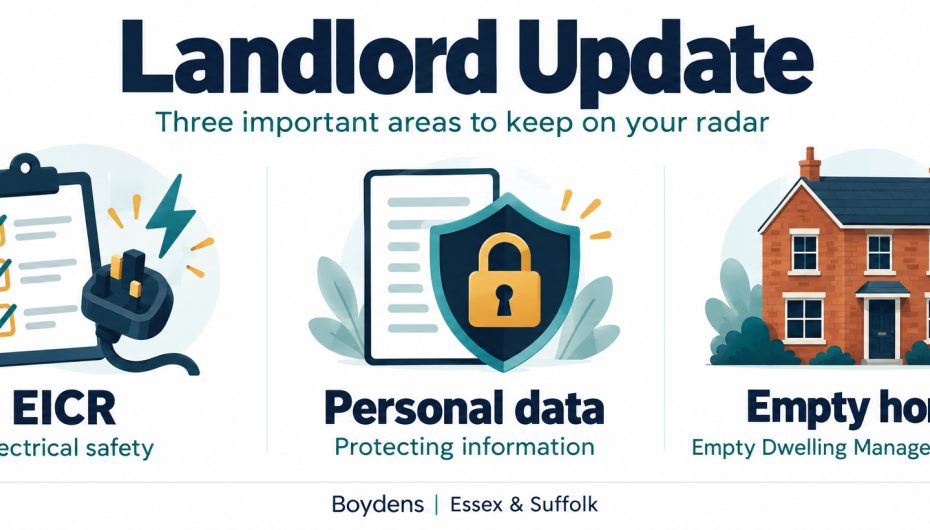
This Weeks Update - Electrical Safety Changes, Protecting Personal Data & Empty Dwelling Management Orders
Electrical-Safety Regulations Move Closer
The Government’s proposed changes to the electrical-safety regulations have now been approved by both Houses of Parliament.
They are expected to come into force on 30 November 2026, although the final statutory instrument must still be formally made before the changes become law.
The principal changes are:
- Electrical inspections will need to follow the updated BS 7671:2018+A4:2026 wiring standard.
- A landlord will not automatically need a new electrical inspection before every new tenancy.
- An existing Electrical Installation Condition Report—usually referred to as an EICR—may be used if the inspection took place within the previous five years and the report is still current.
- A report will only be current if the date specified for the next inspection has not passed.
This last point is important. An EICR does not always remain valid for the full five years. An electrician may specify that another inspection is required sooner, depending on the condition of the installation.
The changes will also remove certain references to “further investigative work” to reflect the revised wiring standard. However, the change is not expected to apply retrospectively. Further investigative work identified in an EICR completed before the new regulations commence must not simply be disregarded.
What should landlords do?
There is no need to arrange a replacement EICR solely because a new tenancy is beginning, provided the existing report:
- was completed by a suitably qualified person;
- is less than five years old;
- has not reached any earlier retest date; and
- does not contain outstanding safety concerns or remedial work.
Landlords should also continue to act promptly on C1, C2 and other findings requiring remedial action. The proposed changes do not make an unsatisfactory EICR acceptable simply because it is less than five years old.
Boydens will monitor publication of the final regulations and confirm the implementation requirements once they are formally made.
A Reminder About Protecting Personal Information
The Information Commissioner’s Office recently took enforcement action following a ransomware attack in which personal information relating to approximately 3,300 people was compromised.
The attack exploited an old test account that had remained available for more than 12 years and was protected by the weak password “Password1”.
The regulator identified several failures, including:
- inadequate password controls;
- failure to remove dormant and test accounts;
- incomplete reviews of user and administrator access;
- insufficient use of multi-factor authentication; and
- unclear responsibility for security where services had been outsourced.
This enforcement action does not introduce a new obligation specifically for landlords. It does, however, demonstrate how basic security failures can lead to a serious personal-data breach.
Landlords may hold identification documents, tenancy information, bank details, references, correspondence and other personal information relating to tenants and applicants. This information should be stored securely and only retained for as long as there is a proper reason to keep it.
Simple steps landlords can take
- Use strong, unique passwords for email, cloud storage and property-management accounts.
- Activate multi-factor authentication wherever it is available.
- Delete or deactivate old accounts that are no longer required.
- Avoid emailing sensitive documents unnecessarily.
- Do not share account credentials with contractors or other third parties.
- Check that anyone processing personal information on your behalf has appropriate security arrangements.
- Securely delete tenant information once it no longer needs to be retained.
This article is based on information available on 26 October 2026 and provides general guidance rather than individual legal advice.
Further reading:
- Draft Electrical Safety Standards Amendment Regulations 2026
- ICO enforcement announcement and cybersecurity guidance
Empty Dwelling Management Orders
If you own a property that is currently empty, a forthcoming change to councils’ powers is worth being aware of.
From 5 November 2026, councils in England will be able to apply for an Empty Dwelling Management Order (EDMO) once a home has been wholly unoccupied for six months, rather than two years. The change applies to applications submitted from that date.
An EDMO allows a council to take over the management of an empty home to bring it back into use. You retain ownership, and the council cannot sell the property under the order. Councils will also no longer have to provide information about nuisance or community support as part of their application.
Does six months empty mean the council automatically takes over?
No. The council must follow a formal process and obtain authorisation from the First-tier Tribunal for an interim order. It must make reasonable efforts to contact you and establish your plans for getting the property occupied.
During an interim order, your consent is needed to let the property. However, a subsequent final order can allow the council to manage and let it without your consent, for up to seven years.
Are there exceptions?
Yes. These include properties genuinely being marketed for sale or letting, holiday homes, and certain homes left empty because the owner is temporarily away or receiving or providing care.
Where the owner has died, an exception generally applies until six months after the grant of representation, such as probate. Each situation needs to be considered against the relevant conditions.
What should you do now?
If your property is empty, we recommend:
- Record the dates and reasons: Keep a clear record of when it became vacant and why.
- Keep evidence of marketing: Retain listings, viewing records, offers and correspondence demonstrating genuine efforts to sell or let.
- Document any works: Keep quotations, contractor bookings and a realistic timetable for bringing the property back into use. Do not assume refurbishment alone creates an automatic exception.
- Respond promptly to the council: Explain your circumstances, provide supporting documents and set out your plans.
- Check before re-letting following possession: If you recovered possession to sell or move into the property, restrictions under the Renters’ Rights Act may apply. The EDMO changes do not give you permission to disregard those restrictions. The Government acknowledges that the two regimes can overlap.
The practical message is to have a clear plan for your empty property and keep evidence of the steps you are taking.
If your property is empty, approaching six months of vacancy, or you have received an enquiry from the council, please contact your local Boydens office for guidance. Our teams in Colchester, Kelvedon, Frinton-on-Sea and Sudbury can help review your sales or lettings options and identify where further specialist advice may be needed.
You can read the Government’s explanatory memorandum here.
Keeping landlords informed
Property regulation continues to change quickly. Boydens will continue monitoring the electrical-safety regulations and other developments affecting landlords, providing further guidance as implementation dates and practical requirements are confirmed.