

News at Boydens
 10th June 2026
Life After Section 21: Winners, Challenges and Market Impact
For years, landlords, tenants and letting agents have operated within a framework that included Section 21 notices, often referred to as "no-fault evictions". Whether viewed as an essential safeguard for landlords or an unfair mechanism for tenants, there is no denying that Section 21 has shaped the rental market for decades.
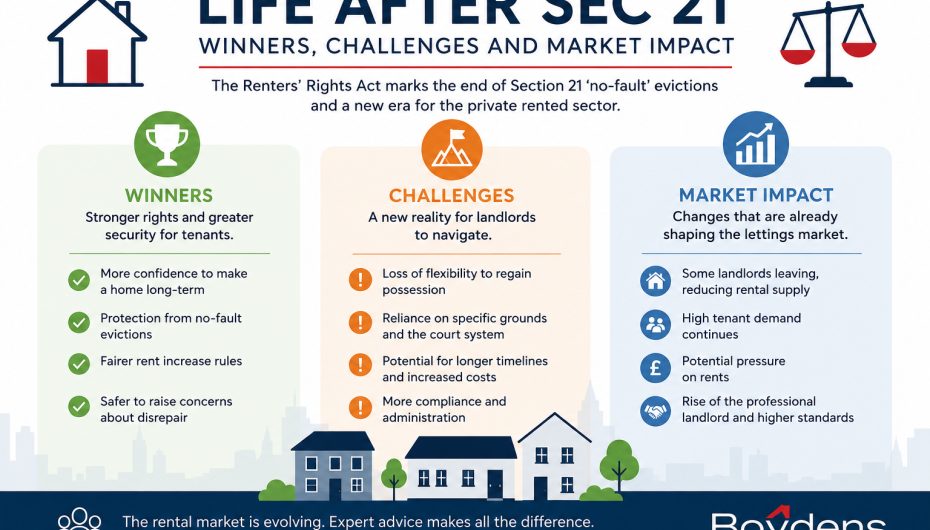
Now, with the introduction of the Renters' Rights Act, Section 21 is being consigned to history. The legislation promises greater security for tenants, increased accountability for landlords and a more professional private rented sector. However, as with any major reform, there are winners, challenges and wider market implications that are already beginning to emerge.
So, what does life after Section 21 really look like?
Understanding the End of Section 21
Before exploring the impact, it's important to understand what has changed.
Previously, Section 21 allowed landlords to regain possession of their property at the end of a tenancy without having to provide a specific reason. While landlords still had to follow strict legal procedures, the process offered flexibility when circumstances changed.
Under the Renters' Rights Act, this route has disappeared. Instead, landlords must rely on specific possession grounds, such as selling the property, moving into it themselves, serious rent arrears or anti-social behaviour.
The government's objective is clear: provide renters with greater security and confidence in their homes while creating a fairer balance between landlords and tenants.
The Winners: Greater Stability for Tenants
For many tenants, the reforms are a welcome development.
One of the biggest concerns among renters has always been uncertainty. The possibility of receiving notice to leave a property, despite paying rent on time and looking after the home, has created anxiety for many households.
The abolition of Section 21 is designed to change that.
Tenants will have increased confidence that they can remain in their homes unless there is a legitimate reason for possession. Families can make longer-term plans, children can remain in local schools, and renters may feel more comfortable raising maintenance concerns without fear of losing their home.
The introduction of stronger protections against unfair rent increases and the move to periodic tenancies also provide greater flexibility and transparency for tenants.
In many ways, the legislation reflects the growing reality that renting is no longer a short-term arrangement for many people but a long-term housing choice.
The Challenges: A New Reality for Landlords
While many landlords support efforts to raise standards across the sector, there are understandable concerns about how the new rules will work in practice.
For responsible landlords, the biggest issue is often not the principle behind the reforms but the practical implications.
The loss of Section 21 removes a degree of certainty. Landlords who need to sell a property, recover possession for family reasons or deal with problematic tenants will now rely entirely on the court system and the specific grounds available under the legislation.
Many landlords have expressed concerns about:
- Longer possession timelines
- Court delays
- Increased administration and compliance requirements
- Reduced flexibility when personal circumstances change
- Greater financial risk when dealing with rent arrears
These concerns come at a time when landlords are already facing increased mortgage costs, taxation changes, licensing requirements and ever-expanding regulatory obligations.
For some smaller landlords, the cumulative effect has prompted difficult decisions about whether remaining in the sector remains viable.
The Impact on Rental Supply
One of the most closely watched consequences of the Renters' Rights Act is its impact on the availability of rental homes.
Across the country, demand for rental property continues to outstrip supply. In many areas, prospective tenants are competing against dozens of applicants for a single property.
At the same time, industry data suggests that some landlords have already chosen to reduce their portfolios or leave the market altogether.
The reasons are varied. For some, it is the Renters' Rights Act. For others, it is the combination of legislative reform, rising interest rates, increased taxation and ongoing compliance costs.
The result is a market facing a difficult balancing act.
While tenants are gaining stronger rights and protections, reduced housing supply could place upward pressure on rents and make finding suitable accommodation more challenging.
This is perhaps the greatest challenge facing policymakers and the industry alike: improving tenant security while ensuring there are enough landlords willing to provide homes.
The Rise of the Professional Landlord
One trend that is becoming increasingly clear is the continued professionalisation of the private rented sector.
The days of accidental landlords operating with minimal knowledge of legislation are rapidly disappearing.
Success in today's market requires landlords to:
- Understand changing legislation
- Maintain high property standards
- Keep accurate records
- Respond promptly to maintenance issues
- Work closely with experienced letting professionals
Those who embrace these responsibilities are likely to continue thriving.
In fact, many professional landlords see the reforms as an opportunity to improve standards and enhance the reputation of the sector as a whole.
What Does the Future Hold?
The full impact of the Renters' Rights Act will not be known overnight.
As the legislation beds in, there will undoubtedly be adjustments from landlords, tenants, agents and the courts themselves. Some challenges will become apparent, while other concerns may prove less significant than initially feared.
What is certain is that the relationship between landlords and tenants is changing.
The future private rented sector is likely to be more regulated, more transparent and more professional than ever before.
For tenants, this should provide greater security and confidence.
For landlords, success will increasingly depend on preparation, compliance and proactive management.
Navigating the New Landscape
The rental market has always evolved, and the most successful landlords are those who adapt to change rather than resist it.
Whether you own a single buy-to-let property or manage a larger portfolio, understanding your rights and responsibilities has never been more important.
At Boydens, our lettings experts work with landlords and tenants across Essex and Suffolk every day, helping them navigate changing legislation and make informed decisions.
If you would like advice on how the Renters' Rights Act may affect your property, portfolio or tenancy, our experienced team is here to help.
Contact your local Boydens office today and speak to one of our lettings specialists.