

News at Boydens
 1st September 2026
EPC "C" RATING - DO I NEED TO DO ANYTHING NOW...
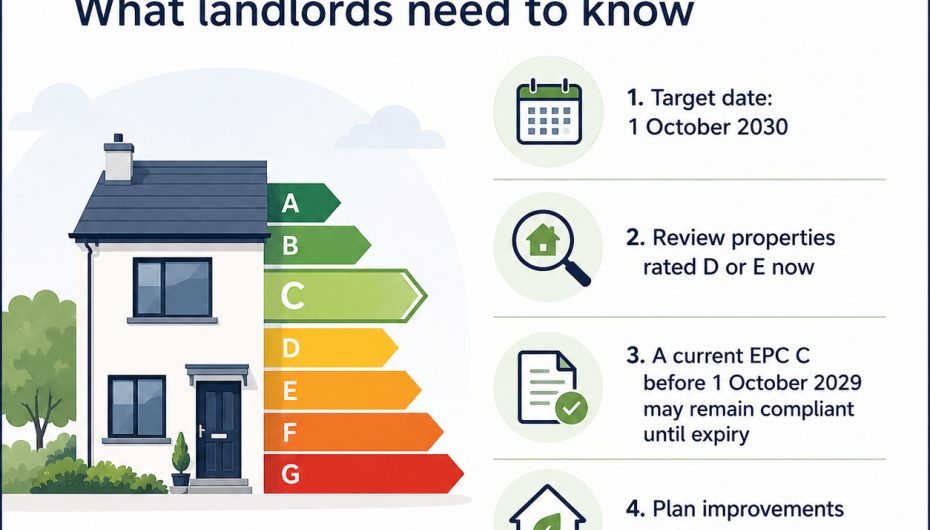
The Government has confirmed its intention that, from 1 October 2030, privately rented properties in England and Wales will need to meet the new EPC C equivalent standard, unless a valid exemption applies.
Although October 2030 may still seem some way off, there are some important decisions landlords should be considering now, particularly as the way EPCs themselves are calculated is also changing.
What is changing from October 2030?
At present, most privately rented properties must achieve a minimum EPC rating of E.
From 1 October 2030, this will increase to the equivalent of an EPC C and will apply to both new and existing tenancies. There will not be an earlier deadline simply because a new tenancy starts.
However, the new standard will be measured differently from the EPC that landlords are familiar with today.
The new EPC C will not just be one rating
The current EPC is largely based around an Energy Efficiency Rating, or EER, which produces the familiar A to G rating.
The Government is changing this system and future domestic EPCs are expected to show four separate headline measures:
• Fabric Performance – how well the building itself retains heat, including insulation, walls, roof, windows and floors.
• Heating System – how efficient and low-carbon the property's heating system is.
• Smart Readiness – the property's ability to make use of smart technology, manage energy consumption and potentially generate or store energy.
• Energy Cost – an indication of the property's expected energy running costs.
For privately rented properties, landlords will need to meet the required C standard for Fabric Performance first, and then meet C in either Heating System or Smart Readiness.
This is an important change because a property that currently achieves an EPC C may not necessarily achieve exactly the same result when it is eventually assessed under the new methodology.
Are EPC assessments themselves changing?
Yes.
The Government is developing the Home Energy Model (HEM), which will ultimately replace the current SAP/RdSAP methodology used to calculate domestic energy performance.
The introduction of the new-style EPC has been delayed and is now expected during the second half of 2027.
The intention is to make EPCs more representative of the actual characteristics of a property and provide clearer information about what improvements should be made.
The precise banding and calculations that will determine what constitutes a C under each of the new measures are still being finalised, so this remains an area we are closely monitoring.
There is an important opportunity for landlords before October 2029
One of the most significant parts of the Government's announcement relates to properties that can achieve an EPC C under the existing Energy Efficiency Rating.
If a privately rented property achieves EER C or above before 1 October 2029, the Government has confirmed that this will be recognised as compliant with the new 2030 standard until that EPC expires or is replaced.
As EPCs will continue to have a ten-year validity period, this could be extremely valuable for landlords whose properties are currently a high D and can relatively easily be improved to a C.
For example, where relatively modest works could take a property from a D to a C, there may be considerable merit in carrying out those improvements and obtaining an updated EPC before the October 2029 cut-off.
How much could landlords be required to spend?
The Government has set a proposed maximum investment requirement of £10,000 per property over a ten-year period.
Importantly, qualifying energy efficiency expenditure incurred from 1 October 2025 onwards can count towards this cap.
Government modelling currently estimates the average cost of bringing an affected property up to the required standard to be approximately £5,400, although naturally this will vary considerably depending upon the age, construction and existing efficiency of the property.
If a landlord has spent the maximum qualifying amount and the property still cannot achieve the required standard, they should be able to register a cost-cap exemption, which will normally last for ten years.
There will also continue to be exemptions where particular works cannot reasonably be undertaken, together with additional protection proposed for certain lower-value properties.
What sort of improvements are we likely to see?
The Government's approach places particular emphasis on improving the fabric of the building first.
We are therefore likely to see increased importance being placed on measures such as:
• Loft and roof insulation
• Cavity or solid wall insulation
• Floor insulation
• Improved windows and doors
• Draught proofing
• Hot water cylinder and pipe insulation
• Heating controls
• More efficient heating systems
• Smart energy controls and smart meters
• Solar photovoltaic panels and other suitable technologies
However, we would caution landlords against automatically carrying out every recommendation currently appearing on an EPC.
The new assessment methodology is changing and some of the detailed thresholds are still being finalised. Major expenditure should therefore be properly assessed before works are commissioned.
What happens if my property is currently a D or E?
There is no immediate reason to panic.
The existing minimum EPC E requirement remains in place for the time being.
What we would recommend, however, is that landlords start looking at their properties individually rather than waiting until 2029 or 2030.
A property sitting at EPC D with a score very close to C may require relatively little investment and could potentially benefit significantly from achieving C before the October 2029 transition deadline.
A low D or E property may require more planning and it would be sensible to understand the potential costs now rather than discovering them shortly before the deadline.
There is also likely to be considerably greater demand for energy assessors, insulation contractors and retrofit specialists as 2030 approaches, which is another reason why leaving everything until the last minute may prove expensive.
Our recommendation to landlords
Our advice at this stage would be:
1. Check the current EPC for every property you own.
Understand its current rating, score, expiry date and recommended improvements.
2. Pay particular attention to properties currently rated D or E.
These are the properties where some forward planning is likely to be required.
3. Identify properties that are close to achieving a C.
Where sensible and cost-effective improvements could achieve an EER C, there may be a considerable advantage in doing so and obtaining an EPC C before 1 October 2029.
4. Concentrate initially on sensible fabric improvements.
Insulation and other improvements to the building itself are likely to remain important under the new system and can also improve the property for the tenant immediately.
5. Be cautious before committing to major expenditure purely to improve an EPC.
For significant works, particularly changes to heating systems, solar installations or expensive retrofit projects, obtain appropriate professional advice first.
6. Keep invoices and evidence of any qualifying improvements.
Expenditure on eligible works from 1 October 2025 onwards may be important when demonstrating compliance with the £10,000 cost cap.
Most importantly, do not wait until 2030.
Our recommendation is that landlords use the next couple of years to understand where each property within their portfolio sits, deal with the straightforward properties first and develop a longer-term plan for those that are likely to require more substantial investment.
There will undoubtedly be further guidance as the new EPC system is introduced and the final scoring criteria are confirmed. We will continue to monitor these changes closely and keep our landlords updated as further information becomes available.
As always, our aim is to give landlords sufficient notice to plan for changes rather than having to react to them at the last minute.